Generate SHA-256, SHA-512, SHA-1, and MD5-like hashes using the Web Crypto API.
A hash generator applies a cryptographic hash function to any input — text, a password, or a file — and produces a unique, fixed-length output called a hash value or digest. It’s a one-way process: you can turn text into a hash, but you can’t turn a hash back into the original text.
Hashes are made of hexadecimal characters (0–9 and a–f), and their length depends entirely on the algorithm — not the size of the input:
Change a single character in the input above and every hash changes completely — that’s the avalanche effect, and it’s what makes hashing so reliable for catching even the smallest change in data.
Compare a downloaded file's hash against the one published by its source to confirm nothing was altered.
See how systems turn passwords into irreversible digests instead of storing them as plain text.
Compare hash values instead of full file contents to quickly spot identical files or text.
Confirm evidence or log files haven't changed since they were first recorded.
Understand HMAC-style verification used to confirm webhook and API requests are genuine.
Experiment with different algorithms and see the avalanche effect happen in real time.
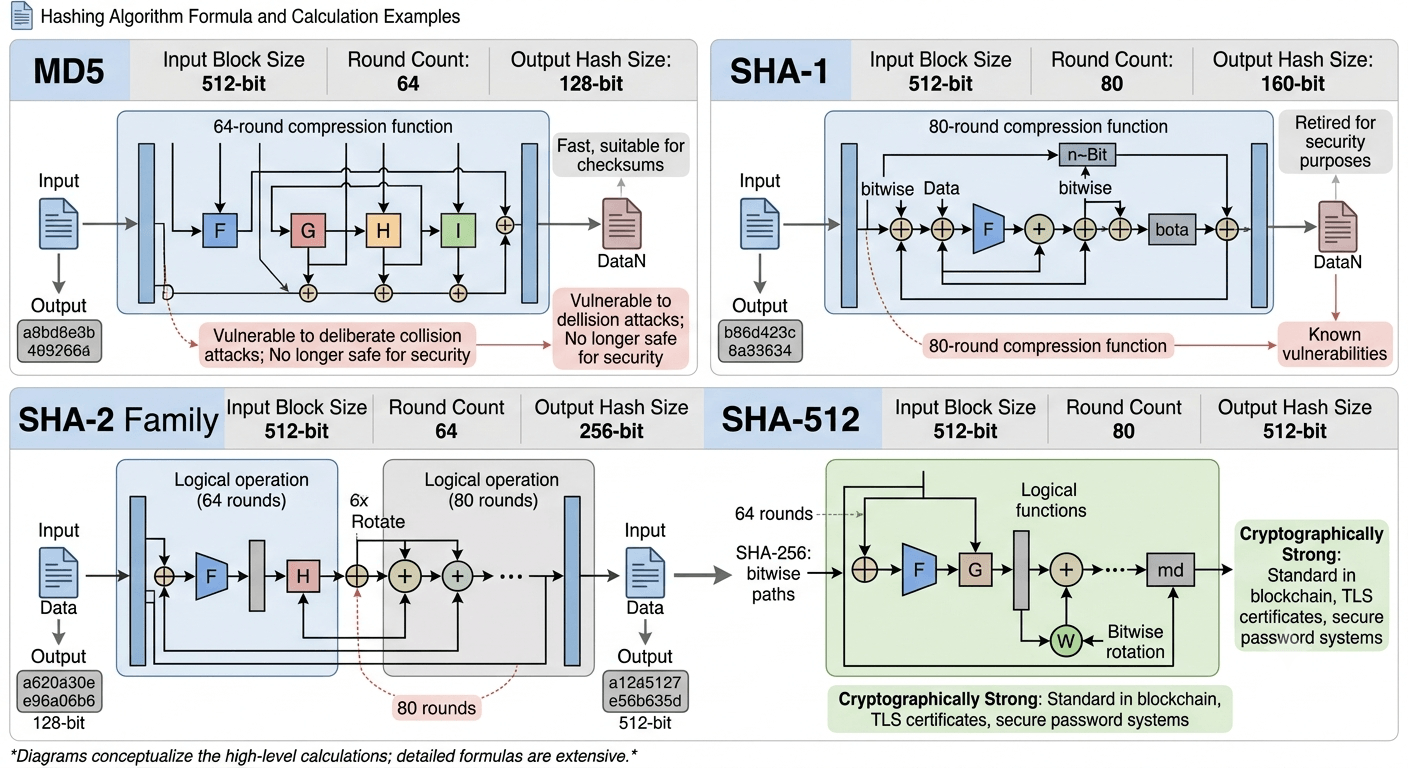
D5 processes input in 512-bit blocks through 64 rounds of a compression function, producing a 128-bit hash. It’s fast, but no longer safe against deliberate collision attacks — fine for checksums, not for security.
SHA-1 also uses 512-bit blocks, run through 80 rounds of bitwise operations to produce a 160-bit hash. Like MD5, it has known vulnerabilities and is largely retired for security purposes.
SHA-256 and SHA-512 (the SHA-2 family) use a more complex compression function — 64 rounds for SHA-256, 80 for SHA-512 — of logical operations, additions, and bitwise rotations. Both are considered cryptographically strong today and are standard in blockchain, TLS certificates, and secure password systems.